Friday, April 29, 2011

Punnett Squares

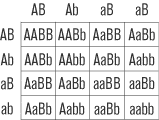
(the punnett square is similar to this)


Today, at the beginnning of the class Mr. Finley checked last nights homework. After we recapped what we learned yesterday for the people who were at Take your daughter/son to work day. (ex. BbGg) Speaking of the eye color....Mr. Finley changed the G eye colors. G is more green/hazel and g is less green/hazel.


Then we went over the homework. The chance for a child with both diseases would be 6.25% (1/16 of the punnett square). The chance for the child to be normal would be 56.25% (9/16 of the punnett square). The chances of the child to have the disease galactosemia is 18.75% (3/16 of the punnett square). The chances of a child getting the disease PKU is 18.75% (3/16 of the punnett square).


OFF TOPIC BUT: POSSIBLE FINAL TEST.....BE PREPAIRED.


Next we were reborn, into a bug called a reebop. Our purpose is to born ourselves. (or make our own traits.) After, we recived worksheets stating the bugs general information. They consist of these genotypes:


  • L l-Legs: long or short (all legs are black)


  • R r-Eye Color: red or black (the rest of the head is the same color as the body)


  • BG BR b- Body Color: blue, red or green. (the g and r are super scripts)


  • S s- Spots or No Spots (spots are all black)


  • W w-Wings: Wings Or No Wings (All wings are transparent. Color what is under them lightly.)


  • C f-Antenne: Curved antennae or feathered antennae. (these are incompletely dominet: they are all brown.)


  • X Y- the sex


  • H h-yellow head disease recessive and linked to males.


* WE DIDNT GET TO FINNISH....DONT DO IT FOR HOMEWORK*


-TORI FUSCO ROUND 5 <3333

Tuesday, April 19, 2011

Blood Types

In class today, we started talking about blood types. There's blood type A, B, AB, and O. All the types are different, but all have the same basic structure. Below is a picture of a blood cell. There are different types of blood cells and different parts of a cell.
Types

-Reb Blood Cells: they transport oxygen to, and remove carbon dioxide from, the body tissues

-White Blood Cells: fight infections

Parts

-Platelet: help the blood clot (Ex. you get a cut and it scabs over)
-Plasma: contains salts and different types of protiens


We also learned that there are different blood grouping systems. As I stated in the beguining, there are four types of blood types which go in to groups. The four groups are A, B, AB, and O. The following will show and tell you how they are in these groups.
Group A
In group A, there's A antigens present and B antibodies.


Group B
In group B, there's B antigens present and A antibodies.


Group AB

In group AB, there's A and B antigens present and NO antibodies.


Group O
In group O, there's NO antigens present and A and B antibodies present.


We also talked about people with certain blood types can only recieve blood from someone with a certain blood type. People with certain blood types can only give to other people with certain blood types. Look below for a better example.

Some people may be asking, "Why do we need to know this?" or "What does this matter? I know I'm not going to become a scientist or a science teacher." Well, what if you do become a scientist. You will have to know which blood type will go to which person after a blood drive. If you don't know what blood type the blood is, the wrong blood will go to the wrong person. That person will then have their original blood cells fighting the new blood causing the red blood cells to break and contents leak out which are toxic.


One thing that may be difficult would be figuring out which blood type will work for which person when they distribute the blood. If you need help with this you can study the table above. If you still need more help, go in and ask for extra help or ask Mr. Finley for help.


For more information you can go to the website we used in class today.


EM.

5th Blog

Monday, April 18, 2011

April 18, 2011


Welcome back to school! Today we began class when Mr. Finley told us that we were going to be tasting the flavor of new gum! Each person chooses a piece of paper which had the flavoring on it. Everybody put the piece of paper in their mouth and wrote down their description. This was my description...
The flavor tasted bitter. It tasted awful and it had an after taste. The flavor was way too strong and didn't even taste like it was supposed to be a flavor of gum.
Then everybody compared what they tasted. Some people said it was bitter and some didn't taste anything at all. Mr. Finley gave us 2 options:
1) Tasted like nothing or just paper
2) It tasted bitter
Most of the class raised their hand for the second option. Then we found out the truth: we were not tasting the new flavor of gum. It was a special chemical (that would not harm us) that only some people can't taste.
Then we answered these questions with our table:
  • What is the phenotype?
  • What are the genotypes?
  • Which trait is dominate?
For the first question we said that the phenotype was being able to taste it or not taste it.
For the second question our table said that the genotype was either BB, bb, Bb, or bB. The b represents the bitter taste.
For the third question we said that being able to taste the chemical was dominate.
BB was homozygus (same thing) dominate- could taste
bb was homozygus (same thing) recessive- could not taste
Bb and bB were heterozygus (different)- could taste
Then, Mr. Finley showed us 4 test tubes of blood. We all agreed that they looked the same. We listed the 4 blood types which are A, B, AB, and O. We are going to learn more about this tomorrow.

-Sara M. :D
Round 5

Wednesday, April 6, 2011

Wednesday, April 6, 2010


Today,

We were given the following question to answer:

Think about Harry Potter. Think of Hermione and her family, Ron and his family, and Harry and his family. Create Punett squares for the passing of magic traits.

First, we have tofind what gene is recessive, muggle or magical. We used this evidence:


  • most people are muggles

  • Harry's grandparents and aunt on his mother's side are muggles

  • all of Ron's family is magic.

Since most people are muggle, that means muggles are dominant over magic people. This really solves the whole problems. We know know how to show dominant and recessive traitsw for the family's.


Unfortanetly, I can't show the punett squares but we learnt that Harry Potter's parents are:


Dad- mm


Mom- mm


For Hermione's parents:


Dad- Mm


Mom- Mm


And Ron's Parents:


Dad- mm


Mom- mm


Hope it helps to let you understand recessive and dominant genes!


Mark V. 5th time.

Tuesday, April 5, 2011

Tuesday, April 5th

Punnett square Above

TEST THURSDAY!

Important Vocabulary:
Punnett square- A square used to find the probabilities of genotypes for one person.
Genotype- The makeup of two alleles. (BB, or Bb)
Phenotype- The observable trait of an organism
Homo- Same
Hetero- Different
Heterozygous genotype- Different alleles (Bb)
Homozygous genotype- Same alleles(BB, bb)

First off, we went over Monday's homework that included Punnett squares.

Then, we talked about dominant and recessive genes using Punnett squares. If Corinna cannot curl her tongue, she must have two lowercase or recessive genes (i,i). Her parents would then have two have one dominant and one recessive gene for tongue curling to have a baby that cannot curl their tongue. (I,i)


REMEMBER: A Punnett square is the probability for ONE person.

The upper case letter is ALWAYS the dominant gene.

Use the same letter when talking about the same trait.

Adding dominant or recessive to the end of homozygous (ex. homozygous recessive) will mean the pair is either all recessive or all dominant.

Links:


Tim Sienko
(5th Round)

Monday, April 4, 2011


HOLLA peoples. Today we handed in our papers about genetics and meiosis. If you havent handed your's in yet, then get it in as soon as possible.


Mr. Finley gave us some vocabulary terms and we had to come up with definitioins. This is what the five guys came up with.


Dominant An allele that needs only one of its type in a homologous pair in order for that gene to be shown in the phenotype.


Recessive An allele that needs two of it type in the homologus pair in order for it to be shown in the phenotype.


Phenotype are the genes that can be observed from the outside.


Genotype all the genes inside and outside that you have but can't see.


When we compare this to the pea soup experiment, we can say...... (look to picture above)
This is because, phenotype is what you can see and you can see the peas texture and color but you can't see its genotype or the homologous pairs in this case. The reason that yellow is dominant is because the probability of getting it is higher. There is a 3/4 chance of getting at least 1 capital Y and a 1/4 chance of getting two lowercase Y's. this is also why green is recessive. There is less of a chance of getting it. The same goes for wrinkled and smooth peas just using R's.

For the rest of class, we discussed the answers to these questions and how they related to the pea soup experiment.

Unfortunately time flew when we were having fun and the period quickly came to a close


Colin Forbes!!!! Round 5

Friday, April 1, 2011

The Pea's Gentic Code

Hey guys! Today is April 1st so HAPPY APRIL FOOL'S DAY! Anyway-when we came in to the class room-Ms.Caroline Schlobohm had a poster on the pea simulation and what happened in our group (Sara M. Elizabeth M. + ME!!) and what we observed. Our group had saw that the wrinkley pea gene can skip a generation. Just like us!!! If you've notices, some of the traits you have might not have come from your parents-but from the generation before your parents-GRANPARENTS!!! Then we talked about the combonation of the R and Y under the pea. Why were the letters in that specific order? Well we discovered that the children PEA's got their R and Y combo's from their parents. Well now ur saying "Well DUHHH!" but there was a pattern in which the Ys and the Rs got split amoung the children and why they were in that kind of order. Well the order is in an organized way! Its like a tree diagram and probability in SCIENCE! Math and science? Together? WOWOWOOWOWOW. Well look at the picture on the side to see how the pea's genetic info got passed from the pea's parents to the children. Just remember when you looking at this picture that the top 2 Y pairs are the parents and the bottom 4 are the children! (**When the line is drawn from one parents Y's to the other-make sure that line is the same color as the new genetic Y code below for the kids. The blue line goes with the blue code. The green line goes with the green Y code-and so on.) Well guess what? Its the same thing for the R's too!! After we were done talking about how some traits in the pea(like wrinkles) can skip a generation we talked about those funny little numbers under the yellow and green peas. What were they? What did they represent?!!?!?!?!? Well-Mr.Finley put the simulation up on the smart board and we observed from the first set of PEA's given to us! We observed that:

  • Because of the way the parents are ordered the children are ordered the same way.

  • All the rough pea's must have the combination of rr. There is no other combination for the rough pea gene.

  • Yellow pea's have atleast one upercase Y

  • Y combinations disiffer the pea's colors.

  • R combininations disiffer the pea's shape.

  • yy=green pea

  • rr=rough pea

  • there has to be atleast one upper case R for the pea to be smooth
Then we tried proving what we observed in the first part of the PEA simulation was true by breeding a yellow pea and seeing what happened. Then we started to put things together. What does meiosis have to do with this?!?!?!? How do genes and meiosis on common grounds? Well guess what?!!?!!! They are on common grounds. You need the genes to do meiosis!!!!! The Y's from the pea are in the sperm and egg cells! WOW! no way??? Haha. Well when the sperm and egg come together to make the zygote the sperm has 5o% of the DNA and the egg has 50% of the DNA. And when they come together to form the zygote its 100% in the new cell! The Y combonations from the Pea cells are the HOMOLOGOUS CHROMOSOMES!!! And the Y combonation's are like the Zygote! Look at the picture for more detail! Holy Moly Maccaroni! What a day in science!! Claudia Lucciola <3333 Round 5!

Thursday, March 31, 2011

Samantha's Blog

Heyy guys today we had a sub. We were supposed to read pgs. 101-107. This is section 4.1

Living things inherit traits in patterns-


  • During sexual reproduction a cell containing genetic information from the mother and a cell containing genetic information from the father combine into a completly new cell, which becomes the offspring.

  • A gene is a unit of heredity that occupies a spacific location on a cromosome and codes for a particular product.

  • Heredity is passing of genes from parents to offspring.

  • The various forms of the same gene are called alleles.

  • An organism's phenotype describes the actual characteristics that can be observed.

  • Genotype is the name for the genes an organisms has.

  • A dominant allele is one that is expressed in the phenotype even if only one copy is present in the genotype- that is, even if the other allele is an alternative form.

  • A recessive allele is one that is expressed in the phenotype only when 2 copies of it are present on the homologs.

Ex. Hair color is determined by multiple genes, can be affected by the environment, and sometimes changes over time. In somecases it has a dominantrecessive pattern similar to that of the eye fold gene. A brown haired mom or dad can have a bloned haired child. The allele for brown hair is dominant.


Answer questions 1-8 on pg 107 after reading this


That is basically it and that is the important stuff!


Samantha Caggiano Peiod 4 4th time

Wednesday, March 30, 2011

Pea Genetics and Heredity

We started class by going over our homework. The big idea is that we inherit physical and personality traits from our parent and other people in our family. We continued with our pea experiment. If you weren't able to get all the peas the same, you have to continue. If you did, you have to start over. In my group, we started with 2 wrinkled peas,one yellow, and one green. The first four times, we breeded two children that were exactly the same and the last time, we self-breeded one pea. Big Question: WHAT ARE WE DOING? Answer: We're developing a model to predict what the next generation will look like. Sample Prediction for breeding a wrinkled green and a smooth yellow: 2 green, 2 yellow, 2 wrinkled, and 2 smooth.

Science is about:


  • Elimanating the wrong answers

  • Finding a pattern

  • Sharing ideas

It's NOT about being right.


Nobody created all of science.


CC Blog #4

Tuesday, March 29, 2011

Pea Soup link

Today in class, we went on Mr. Finley's website and we are making a list of everything we see on the pea soup link. Right away we saw peas. The peas are all the same size and color. Some are wrinkled and some different shapes. One group thought they were yellow while others thought they were green. The also thought that the green ones were more wrinkled then the yellow ones. Some are different then others. Everyone in the room has a different simulation. So everyone is looking at different things. Like parents, everyone has different parents so all the kids look different. Lea's group noticed that there is one "odd ball" which means it looks different from the rest. At the top they show the parent peas with two children peas. Underneath the children there are radio buttons, which make them breed. They can self-pollonate. We were talking about how the parents look like the children. We chose peas to breed and predicted what would happen. If we weren't wrong we have to go back and change our hypothesis. We go back untill we get it right. Some of us predict that they will stay the same while others think that there will be a 50-50 split. One group thinks that all of them are going to change in some way. Mr. Finley wants us to play 5 times untill we get it right 5 times in a row. It's important to keep track of what you thought and what actually happened. We think it's a good idea to make a table of your results. Happy testing!

CA - 4th time

Monday March 28

Today in cl;ass we continued to do what we did last week. we did the process of Meiosis. we left off at Propahse 2 and started telephase. So for telephase the chromosomes are in bundles far from each other-then line up to seperate. The directors for this phase turned the chromosomes into an x shape. then the picture was taken. Next was Metaphase 2. in this process the directors had spread each group of chromosomes across the side, so they would be facing each other. Since we were running out of people we had to take away one side of the chromosomes so the centriole could pull them apart. Now were on anapahse 2. the directors had done thier job again and had seperated the chromosomes. In telephase 2 the directors had the centrioles remove the spindle fibers so that the chromosomes could smosh up together in big bundled up groups. we finally had fineshed all the phases, and moved on to the next thing in class. miosis and mitosiss are very similar the only difference of them are it is in two. For the rest of class we talked about the zygote form foring fully.the process that we go through to recieve more cells is mitosis. Now that the body continues to go through mitosis every cell will go through it. it has continued now and the boy has become an adolescent. the process we are now on for anormal growing boy is meisos. the meisosis occurs in the testes.- which the sperm cells make and goes through 4 processes. When the male and female perform the delivery method not all is done yet to recieve baby. there about a couple processes. they engage in sexual intercourse to get them in the same place - th sperm has to mix with the egg which is fertilization. if two different sperm cells mix with two different egg cells then you get feternal twins, if they are all the same them they merge and make one sinlge baby. the fertilization occure in the zygote form. then we wrapped up class and all left. Carolina Dimler PERIOD 4 4 round

Thursday, March 24, 2011

today we are doing a BIG TIME REVEIW ! we stared by fixing around the room and the tables into a square. then Mr.finley gaves a number up to 5. then he cold out numbers. they went in to the square. then they got portners of 2 and then the 4 of them got to one side of square. then we are got to modle the steps in mitose. we stored in interphase. they were all in the nuclues.


then they did prophase they got together and make X shaped chromosomes and added centerols. after we put ropes and put it on the X shape chromosomes and the spinldol fibers were add too. this is metaphase. the centrioles that shout out sipindoe fibers that are atached and pulled the chomosomesa part.


then the chromosomes go and atached togother and the newe nucles is formed this is anaphase.

then we stored over in meiosis and did the same as mitose interpgase.


then in prophaase we put to of the pair together and made the crosing over and tritrad.


then we got in a line and put the tritrad in the line and add spindol fiders and centriols.this is metaphase.
then they are pulled a part and to the besty think and but they'r hand out in anaphase.


then this is all we did so for the end see mondays blog.


3/24/11 ariel chacon 11:32 roumd4

Wednesday, March 23, 2011

Wed. March 23


My 1st blog was deleted so i had to start over :(! Today, was s a short period! in class, we talked about crossing over from yesterday. Crossing over is when the chrosomones spilt and take half a piece of each other. in prohase 1, your homlegous pair you connect to them and form a tetard. the picture about crossing over druring meiosis is shwoing how the homlogous pairs changes during each of the stages. Mr. Finley also told us that ><. then he told us to stand on our chairs and he told us if you had brown eyes you died, which is why he asked if you had brown eyes, why did the population decrease? it decrease because most of the students had brown eyes in the class. we went over our homwork and we went to lunch!
-Jodi Bull (4th round) :)

Tuesday, March 22, 2011

Mitosis and Meiosis


Today in class we talked about the similarities and differences between the process of mitosis and meiosis.

Mitosis
-trying to split chromosomes
-end up with 2 cells
-cells are body cells
-asexual
-body cell-growth and repair

Meiosis
-more steps
-meiosis1 spindle fibers connect to one side of chromosome
-happens because we're splitting homologus pairs
-end up with 4 cells
-cells are gametes
-gametes {sex cells}
-sexual
-2 divisions which gets you 4 cells
-crossing over occurs between homologus pairs

Similarities
-DNA and chromosomes
- meiosis 2 is similar to mitosis {splits chromosomes}
- cell division
-utilize centreols
-envolve eukaryotes
-X shaped chromosomes

Notes

-The point of meiosis is to make a new sperm and egg.
-Girls finish meiosis before we are born and don't go through it again
-Meiosis is in the overes
-For boys it starts at 10-13 and they go through it until they are about 70
-It's in the testies for boys
-Meiosis can happen without having a child present


Crossing Over


Crossing Over is when 2 chromosomes split and take a piece of each other (about a quater) the homologus pairs connect and form a tetrad.This happens in prophase 1. A tetrad is a group of chromotids.

-Allie Mansfield 4th time<3

Friday, March 18, 2011

Mr. Finley's class blog- 3-18-11

Egg cell....................................
sperm cell....................................

Happy friday everyone!!!! Tonights the dance!!!! (just reminding everyone, lol). So now onto science. Our homework was to read the questions on mr. finleys homework page and then write the answer in our notebooks or on the computer. These were the questions:

1. If an egg and sperm cell merge, what can you say about the amount of chromosomes each must have?
It must be 50% percent of chromosomes from each cell (egg and sperm) when they merge so that the daughter cell can have 100% of their chromosomes.

2. How does this relate to a homologous pair of chromosomes? (same kind)
Sara attemped but failed at the answer. It's ok, Sara! she said that half come from the mom and half from the dad chromosomes, but Mr. finley objected. Homologous pairs pair by 2's. He explained this on the board. HALF of your homologous pair comes from the mom (chromosomes), HALF of your homologous pair comes from the dad. Good save, Sara! Once again, a homologous pair is two chromosomes that have the same trait. Chromosomes determine how you look, like your physical traits.

3. Could we start with a normal cell, go through mitosis, and end up with an egg or sperm cell? why not?
No this is not possible. You cannot just get a skin cell to produce a egg cell out of nowhere. Plus, cells can only produce cells that are the same kind as them. When we split two skin cells, we need them to have 100% percent of chromosomes for the two new daughter cells to have 100% of the chromosomes as well. But when we have a sperm and egg cell, we need them to have 50% so when they merge, they will create 100% percent for the new cell.

-----------------------------------------------------------------------------------------------

After this, we began reading an article on meiosis. It talked about how flowers are still producing sexually because they self-pollinate and also how diferent mammals and plants reproduce asexually and sexually. Some key terms are:

Haploid- Repeoductive cells containing half of a parent'c chromosomes.


Zygote- Combined sperm and egg cell


Fertilization- process of sperm fertilization of the cell


By the way, Mr. finley added that sexual reproduction and sexual intercoarse are NOT the same thing. (awkward, yes, but nessicary!!)


Now today, (monday) mr finley is away and now we are working on a venn diagram and also a meiosis activity. See you tomorrow Mr. Finley!!!!!!!!!!!!!!!!!!!


That's all!!!!


- Caroline S. (best student ever) :D
- caroline s :D

Thursday, March 17, 2011

3/17/11

The Cell Cycle

First in class, Mr. Finley told us that if we couldn't do the homework from last night because your computers wouldn't open the simulation, you can show him the homework tomorrow. Also, if you can't open the simulation, it works better on older computers.
Paramecium

Next, we discussed with our groups about how a paramecium reproduces. My group said that a paramecium is single-celled and eukaryotic, so the paramecium would go through mitosis. First, there is prophase, which is when chromatin becomes chromosomes and becomes visible, the nuclear membrane breaks down and dissolves, centrosomes become centrials which also move to opposite sides of the cell. Next, there is metaphase. Metaphase is when the centrials create spindlefibers which align the chromosomes at the center of the cell. Then, anaphase is when spindlefibers pull chromosomes to opposite sides of the cell. Lastly, telophase is when a new nucleus forms around chromosomes and the cell starts to pinch closed.

Next, we discussed how we reproduce. We need two parents and the offspring don't look exactly like the parent because it has genetic information from both parents. Also, sexual reproduction and sexual intercourse are commonly mixed up. Remember that sexual reproduction is the actual cells reproducing.

We also learned that....
-sex is just a delivery method that gets the cells where they need to be
-sperm cell- male
-egg cell- female
-other traveling cells are pollen (plants) and spores (fungus)
-sperm cells come from testicles
-egg cells come from ovaries
-zygote- combined cell
When the sperm cell finds the egg, the genetic material combines, it becomes one cell , and the cell continues to grow. When the cell combines, the new cell has 50% of each original cells chromosomes (50+50= 100%).

M.K.B. 4th blog

Wednesday, March 16, 2011

Today in Mr. Finley's class we finished the rest of the slide shows that are getting graded. After we finished the slide shows, we went over our homework from last we about the two animation videos about mitosis and we had to write a paragraph of which video is better to explain mitosis. we also went over our class work from yesterday.


Questions and answers from school work yesterday.


1. How does binary fizzen relate to cell division?

A: it is a form of asexual reproduction occurring in prokaryotic


3.compare sexual reproduction and asexual reproduction

A: asexual reproduction you look exactly like your parent
in sexual reproduction you look some what like your parents. we don't reproduce asexual reproduction we are sexual reproduction.

these are the only two questions that you need to know.

Importent info about chromosomes


  • these are called autosomes which are also chromosomes

  • chromosomes go from two lines to an X shape

  • l l - sex chromosomes

  • when chromosomes are in X shape there special term is called chromotaids - only called this when its in X shape
  • chromosome are always in a pair even when there in X form


Tuesday, March 15, 2011

Reproduction in cell Division

Today in class we are reading pages 88 to 92. We have to answer questions 1 through 6 on page 92.

1) Binary fission relates to cell division because they both reproduce cells.

2) A bud is a process in which an organism develops tiny buds on its body. The buds are formed by the parent cell. This means that the buds genetics are the same as the parent cells genetics.

3) Asexual Reproduction: Sexual Reproduction:
Cell division Cell division and other process
One parent organism Two parent organisms
Rate of reproduction is rapid Rate of reproduction is slower
Offsppring identical to parent Same genetic info as parents


4) No, prokaryotes can not got go through regeneration because they are only single celled and if they are single celled, they will because mitosis die and they can not repair themselves when they are not alive.

5) Binary fission is like mitosis because it has a cell splits and makes new form of itself. The daughter cell is like the parent cell. They are different because mitosis only happens in eukaryotic cells.

6)They have traits there parents dont and vice versa.

Garrett Pope 4th Blog.

Monday, March 14, 2011


in the beginning of class we went on the computers and we started working on our presentations.
Our presentations are about the cell cycle including these parts:
-Interphase (growth, DNA replication, and preperation for cell division)
-Prophase
-Mataphase
-Anophase
-Telophase

On friday we took pictures with our phones after we organized what the cell looks like in each phase, and now we are writing about what happens in each phase.

in INTERPHASE, the DNA duplicates to prepare for mitosis. in interphase the nucleus isnt completely visible.


in PROPHASE, the nuclear membrane dissolves so that you cant see it anymore. the chromotin becomes chromosomes. the centrosome becomes 2 centrials and they move to opposite sides of the cell.


in MEAPHASE, the centromere is connected to the centrials by spindle fibers. the spindle fibers align chromosomes inside the cell.


in ANAPHASE, the paired chromosomes seperate at the kinetochores and move to opposite sides of the cell.


in TELAPHASE, the new membranes form around the daughter nulcei while the chromosomes disperse are not vivible inside the light of the microscope. Cytokenisis can also begin during this stage.


Chromosomes: coiled DNA

Chromatin: uncoiled DNA
ALYSSE MACHALEK (BLOG 4)

Friday, March 11, 2011

Presentations


file://mitosis1/Today in class we started trying something new.
Everyone brought their phones to class,and each group was given a dry erase board,peices of postists, and we are making slide shows of examples of mitosis.
*We also as always have our group leaders.*
The post its were in an order to help us. The cell we are making, is a fruitfly, and each color postit (purple, blue,pink, and yellow) represent chromosomes. The presentation must be from interphase to cytokinesis. First, my group drew a cell, and labled it interphase. We aranged the postits in the nucleus, so the nucleus was very visible. We took a picture with my phone and emailed it to our selfs so we could put it our presentation. We did Prophase, reranged the postits,and took another picture. We repeated the steps, for each stage. While some people are drawing and making the cells, others are making our presentation.


Remember your group leaders, checking for homework, checking the blog calendar, and comenting once a month! (or more)
:)
Natalie (4th)