Monday, February 7, 2011


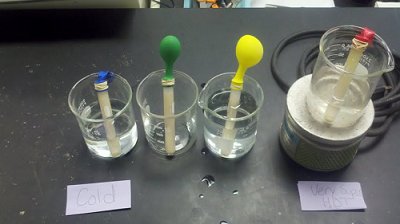
Today in class we talked about the homework, and which graph it is. Also it was c because someone said that they were performing at a low rate when it was cold but didn't die. Mr. Finley gave this example how dogs during the summer they crave wate all the time, and led to why our body needs oxygen to perfore celluar resperation. the yellow ballon was in hot water. the green ballon was in room tempurture and the blue one was cold water. So if tempurture is colder then the organism is going to shut down, so it has to be active.The respiration in the cold water reacted slowly and in the warm tempurture it reacts very fast. For the other nights homework we talked about what the difference about anaerobic and aerobic, and so anaerobic means bascically living or activ in the absense of free oxygen. Pros of anaerobic: Releases energy, good for some of the aquatic orginism, can last longer, Cons of anaerobic: Build up of acid that can be deadly, our by poducts Co2 and Lactic acid, relases energy much slower, less energy, and uses other items in your body and the cells. Realtic acid build up are cramps, occurs when your body doesn;t get enough energy.

Conclusion: If you had a cramp in order to get rid of it, take deeper breaths cause your taking in more oxygen. Slow down a little bit because you won't need as much energy, your cells get a chance to catch up.
-Carolina Dimler

Friday, February 4, 2011

Test Tube Respiration

We started by observing our test tubes ( today is Day 4). Mr.Finley drew four graphs on the board and asked us which one we thinks best represents how respiration works: A,B,C, or D. Graphs C,A, and D show change because overtime, the results showed a change. B, on the other hand, will always stay constant because it's a straight line. The way to see who's on the right track is to test our predictions.

We added 1 ml of yeast, and 1 ml of sugar into three test tubes. Our dependent variable is temperature. We want to find out if the temperature of the test tube will affect cellular respiration. Mr.Finley topped each test tube with a balloon, so we'll know which test tube has the most respiration going on. We poured room temperature, ice, and hot water into a beaker and put it on top of a burner. The ice water is blue, hot water is red, and the room temperature water is yellow. He shook up the first test tube and put it into the room temperature water. Our experiment is to be continued.......
PS. Lab Reports are due Monday!!!!
CC

Thursday, February 3, 2011

Period 4 blog

Today, we are looking at the results of our experiments. One thing that we talk about is how to view the results. We created a table and Mr. Finley created one that shows the observations of the outside and inside of the tube. We also explained about what we should write when making our lab report. We asked what the background was. What got us here? Why did we do this experiment? This helps with the reason for doing it. Similar to the bacteria and cell unit.Take an example. Some TV shows tell you what happens before the episode. Say to friends got into a fight. Later The friends group get into a fight. It is cause and effect.
We also had 5-10 minutes to to finish our quiz for all the people that didn't finish it or wanted to touch up their consept map.
One conclusion that our group came up with is that a test tube with more glucose in it will have more oxygen at the top than a tube with less glucose. The respiration would kepp on going until there is no more sugar. The more sugar, the longer the yeast would take to absorb the glucose.

Tuesday, February 1, 2011

Finley's blog: experiment & worksheet, January 31st, 2011

this is a diagram of photosynethesis! (kinda blurry, sorry!)


this is an example of yeast, the water based organism that we are using in our experiment!


This is an example of a glucose molecule (C6H12O6)


BLOG FOR MR. FINLEY'S CLASS- JANUARY 31ST, 2011


Hey guys! I had some technical difficulties and my blog vanished yesterday before i could post it..... :(. I'm sorry I couldn't post it but i typed up the blog..... again.

Today for homework we had to hand in a worksheet on cellular respiration and photosynthesis. We also had to hand in our procedure, prediction, materials, and hypothesis for our lab report on cellular respiration. The options for our independent variable were; temperature of water, amount of glucose, amount of light, amount of organisms, and different surroundings (colored paper possibly). Here are the correct answers the the worksheet (in order of questions):

1.
- CO2
-H2O
- light source


1b.
-Oxygen (O2)
-Glucose (C6H12O6)

2.
Equation for photosynthesis---- 6CO2+6H2O+ light energy.................... C6H12O6 + 6O2


3.
Fill in the blank: release


4.
Equation for cellular respiration---- C6H12O6+O2........... 6CO2+ATP+6O2


Fill in the blanks diagram

1.CO2 (carbon dioxide)- going into plant
2.O2 (oxygen)- coming out of plant
3.C6H12O6 (glucose)- going down into plant
4.H2O (water)-coming up from roots


Fill in the blanks paragraph (in order of blanks)

1. Energy
2. Glucose
3. Chemical
4. Water
5. Air

NEXT PARAGRAPH
6. food
7. air
8. solar
9. respiration
10. cellulose


---------EXPERIMENT-----------------------------------------------------------------------

Now we are going to conduct our experiment! HOORAY!! We found out that our water based organisms that we will be using are yeast (no sea monkeys Finley??)

Each group decided to do something a little different for this experiment, but my group (Garrett, Caroline, Mary Kate) decided to do the amount of glucose variable.Here is what we started with in our experiment:


MATERIALS
- Test tubes (2)
- 5 ml. of glucose
- 2 ml. of yeast (water based organism)
- smart water


PROCEDURE

For this experiment, we first will have to acquire 2 test tubes. Then, we will fill these test tubes to nearly the top with the smart water. After this, we will put 1 ml. of yeast in each test tube to have an equal amount in each tube. Then, we will put the 5 mls. of glucose into 1 of the test tubes, put stoppers on both tubes, then shake them up. We then will have to wait one day to compare the results of our test.


PREDICTION
My prediction for this experiment is that there will be a lot more bubbles in the tube with 5 mls. of glucose than the tube with no glucose at all. In cellular respiration, one of the two reactants is glucose. So, if one tube has a ton of glucose and the other has none at all, the tube with the most glucose would have the most bubbles. the more glucose there is to take in, the more cellular respiration can occur. The more cellular respiration that occurs, the more bubbles there will be. In conclusion, the more glucose and oxygen and organism can take in to produce cellular respiration, the more bubbles will rise to the surface of the water. So the test tube with the 5 mls. of water is bound to have more bubbles produced than the tube with no mls. of glucose.


HYPOTHESIS

C6H1206+6O2............... 6CO2+6H2O+ATP (cellular respiration)

------------------------------------------------------------------------------------------------

Unfortunately the results and observations of our experiment are not ready yet and will be conducted tomorrow! Thanks so much for reading my awesome blog!!!!!!

- Caroline Schlobs :))

Friday, January 28, 2011


At first we talked about how Mr. Finley knows about all the tricks we do with the homework and extra credit where we say my computer isnt working. He said that he knows that we are lying and that he isnt going to fall for it. for extra credit Mr. Finley wants us to come to him and tell him what we did. he also wanted to make sure that we remember to put our initials on our blog and blog comments, so that he can give us credit. we have to at least 1 blog comment now, but 2 blog comments next blog round.


today we talked more about cellular resperation:


Carbon dioxide comes from glucose.


when you breathe in oxygen, you breathe out the same amout of carbon dioxide.


we get the carbon dioxide from the food that we eat and the glucose in our food and the glucose goes to the miticondria in the cell and the glucose uses the oxgen and produces ATP.


when this happens our body gets rid of water and CO2 and water. we breathe out the CO2 and when we are not sweating, we "waste" the water by using the bathroom.


when you run 5 Ks, you dont only use the food that you ate that morning, you also use the glucose that you store. that is why people who work out a lot are skinny because they burn off the stored glucose.


ATP- a form of energy that we use. It is when the glucose breaks down and creats energy which is ATP.


We planned our labs.


you would need to provide this organism with food and water.


the food that you would need to give it is something with glucose.


with organisms that are in water we would need to out it in water because that is how it is going to get the oxygen because of the equation H2O.


there is plenty of oxygen in water for us to breathe, so why cant we breathe underwater?


we cant because we cant seperate water from the oxygen.


our dependent variable in the experiment is how big the clump of bubbles is.


the independent variable in the experiment is amount of organisms (for our group)


Possible independent varables:


-amout of glucose


-temperature


-light


-color surroundings


-amount of organisms

A.D.M. (Alysse Machalek)

Wednesday, January 26, 2011

Jan. 26 2011


Today in class, Mr. Finley checked our homework. Then, he asked us about the formula from yesteray. it's C6 H12 O6+O2=co2+energy=H2o. then he asked was the equation balanced? one student said, no its not balanced. so, the new balanced would be (6H12 06+602=602+6H20=ATP. he also asked the class if this formula looks fimilar, which it does, its the same as photosynthesis but only backwards. Remember photosynthesis is 6CO2+6H2O+light energy=C6H12O6+602! mr finley asked a question, can we surive without the sun? my group saids no because there will be no photosynthesis for the plants to get oxgen for us to breath in. then, how about eating animals? we said no because animals also eats plants and the plants have the light energy. the last one was, can we eat lions then the lions cant eat us? i said no because in the circle of light, we cant skip a step, also the animals need to eat plants to get energy form the gulcose. also, do we get energy from sun? yes! of course we do! without gulcose, we cant get energy from the sun. why should we eat before a sport event? because the sugar gets disoved said one student in the class we finaly went over our homework, the question was, what is the purpose for photosynthesis? i said to create gulcose which was the correct answer. what is the form of energy we can use? A.T.P! the other question on the homework was, whats the organelle for photosynthesis it was chlorplasts and cellular respiration which is mitochondria. the products in cellular respiration is gulcose and energy. thats what we did in class today! =)

-J.B period 4 =)


Tuesday, January 25, 2011

January 25

GLUCOSE
Today in class we started out by answering some questions in our notebook, while Mr. Finley checked our homework from last night. These are the questions:


Imagine that we just landed on a new planet. Scientists suggest that we start planting green plants as soon as possible.


1) Why would they suggest it?


2) What would we need to know about the planet before we wentwith this plan?


3) Could plants survive in an enviroment with no oxygen?


*Homework quality improved, keep up the good work :)


This is what our class disscusion came up with:


1) Scientists would suggest this so the plants could start photosynthesizing, so the humans there would get the oxygen-glucose that they don't need, so that we could breathe.


2) We would need to know if the planet had water, co2 and sunlight so the plants could perform photosynthesis. You would also need to know if the surface had fetile soil, the plants could grow.


3)Plants could live on a planet without oxygen, because they don't need it for photosynthesis. (the gas not water) But Mr. Finley says plants COULD NOT survive without oxygen.


When we looked back at our notes from last night, we realized cellular respiration is how we get energy. The glucose and oxygen forms a chemical reaction producing energy.

Mr. Finley built "glucose" out of a stick of expo markers. He asked us what we needed to break it down, and it is oxygen. The point of breaking it down is to help you power your cells, its energy. The form of energy is ATP. It is an element.

So back to the question: Plants need oxygen to break down glucose !!!

Another question: Do plants use glucose like we do? Yes they do because they make it.

We are different from plants because they make glucose, and we eat glucose, that we get from food.

To get most of our glucose, we should eat fruits and vegetables and pasta( or bread) because they are from wheat, which is a plant! DING DING DING (lightbulb pops up in your head)

* anyword that ends in "cose" is SUGAR
for cellular respiration we need: OXYGEN AND GLUCOSE
C6 H12 06 +02->C02+ Energy H20 In cellular respiration we end with the reversed result of Photosynthesis.
Also the month is coming to an end so don't forget to make your blog comments.
N.Z